PE lessons: Shearman’s losses and Cravath’s gains show the value of City buyout teams – and the dangers of misfiring

City of London

While it may be an oversimplification to say that there has been a certain inevitability to Shearman & Sterling’s decline in recent months, that the firm’s losses should lead to Cravath, Swaine & Moore’s inaugural foray into English law is a coup even the most clued up of pundits could scarcely have foreseen.

Coming as they did from a venerable Wall Street institution which, while having had a London office for some five decades, has never ventured to hire a single English law practitioner, the hires of buyout partners Philip Stopford and Korey Fevzi from Shearman prompted a wave of speculation when they first hit the industry press in March. Continue reading “PE lessons: Shearman’s losses and Cravath’s gains show the value of City buyout teams – and the dangers of misfiring”

Sponsored briefing: Extraordinary times

Dominic Griffiths, Mayer Brown’s London managing partner, discusses bolstering the corporate practice and getting the cultural fit right

You have been London managing partner for a little over a year now. What have been your personal highlights?

Dominic Griffiths (DG): We have continued our growth trajectory over the last couple of years, in particular our revenue growth. It’s one of the fastest growing offices of Mayer Brown globally, which we’re very pleased with, of course. When I started in the role, I set out three important areas for development and one of them was high quality lateral hires. That was top of my list, and we have successfully continued that process. In the last 24 months, the London office has welcomed 11 lateral partners in key specialisations including banking and finance, private equity, investment funds and litigation and, during the course of 2022, we hired Peter Pears, a capital markets partner from Clifford Chance – he is one of the leading ESG advisers to the capital markets industry. We hired Neil Hamilton, a senior securitisation and regulatory partner, also from Clifford Chance. He is focused on providing bespoke regulatory support for our big structured finance roster of clients. We hired Matt Griffin from White & Case, the European head of its funds practice. He is an excellent, high-level, practitioner who adds to our broad scope of activity in fund formation and funds advice for our big corporate clients. We hired Airlie Goodman from Linklaters. I’ve worked with her personally, even though I’m a transactional lawyer, on a big litigation matter. She is an absolutely exceptional litigator. She fits very well in our elite litigation team. We also hired Ronan Mellon from DLA Piper. Ronan and I worked together many years ago at White & Case. It makes me feel a bit old because he was a junior lawyer then and he’s been a partner for ten years now. He has hit the ground running and he’s had some very successful transaction closings already. Last but not least, Paul Rosen from Katten Muchin Rosenman UK came over into our fast-growing private equity team.

How has the London office performed relative to your expectations?

DG: The last few months have been extraordinary times in the markets and we track those markets closely. Mayer Brown, in New York and London in particular, defines itself as being strong in financial services, with the majority of our partners and practitioners focused on this sector. It has been a very strange market. We saw a decrease in the amount of leverage being provided by banks from around September last year. We were looking very closely at credit funds because we have a lot of fantastic work with credit funds to pick up in that space, but, actually, the expectations of the market have not really been met with regard to the amount of leverage required for a really strong and active market. Notwithstanding all of that, we have a very good private equity and leveraged finance practice, which has remained strong and busy because there are more deals in that market. We’re very well hedged in relation to a market like this. We’ve got an extremely strong restructuring team, which is beginning to get really very busy over the last two or three months and we’ve also got a very large litigation group.

What are your ambitions over the next few years? Is there an area you feel needs to be invested in?

DG: My predominant focus is corporate M&A and private equity. Alongside that, there are a number of other areas which we may enhance. Our litigation team is doing incredibly well but if there’s an opportunity to enhance that further we might add one or two new partners in that area. But we feel that what we need now is to grow our corporate team to match the size and success of our finance and litigation teams.

‘We’re very good at identifying the right cultural fits in terms of people joining the firm, at the most junior level right up to the most senior partners we hire laterally.’
Dominic Griffiths, Mayer Brown

I feel very strongly that it is not just about increased profitability; it’s also about increasing personal capital. Having a really diverse strong group of lawyers and people in business services who love working in the firm. This place has an incredibly strong and healthy work culture. We concentrate on things like mental health and equality, in particular in senior roles and for women and other people with protected characteristics. My ambition in that area is not just to improve the situation of my own law firm, it is to improve the profession.

What is your elevator pitch for attracting new recruits?

DG: We’re very good at identifying the right cultural fits in terms of people joining the firm, at the most junior level right up to the most senior partners we hire laterally. It’s important to identify that. That also means hiring a good diverse group of people and making it a welcoming environment on arrival. We’ve got good levels of retention in this office. People enjoy working here, but also socialising with each other. It’s a friendly, open environment. It’s a flat structure in terms of management. Hopefully management is approachable and accessible and the partners treat their associates as adults and not as second class citizens, which can happen in our profession. It’s incredibly important to consider that we’ve got the best people in business services. Business services individuals are treated with the utmost respect and in an equal fashion to lawyers.

How has the war in Ukraine impacted the practice?

DG: We had no operations in Russia and therefore very minimal levels of exposure, in relation to the war in Ukraine. But we have seen a significant uptick in work in areas like sanctions and disruption to supply chains and disputes. So, there has obviously been a slight change in the type of work that we have been doing.

How would you define the firm’s culture?

DG: Being in the trenches together, collegiality in the face of stressful circumstances, pulling together and getting deals done, and rewarding people for it. We have a good collegiate environment where people are supportive of each other. We also have a balanced culture between the meritocratic and entrepreneurial nature of a US-centric law firm and the collegiality and traditional aspects of a traditional English law firm.

How do you think the firm’s brand is seen in the market and what would you change about that perception?

DG: We believe the market thinks of us as having very high calibre lawyers who work on some of the best mandates available in transactional work and in disputes. We’re considered to be a very reliable law firm in taking on highly complex work and getting deals over the line.

What does the firm need to do to fulfil its ambitions in London?

DG: Top-quality lateral hires and getting the message out there that we are exceptionally good at dealing with highly complex transactional and disputes work. It’s all about growing and strengthening our corporate practice. Maximising the potential we have across our network. We already work very well together on a transatlantic and international basis, but we can always do better in that respect. So, ensuring that we are doing enough in terms of working together with teams outside of London and that there’s enough cross departmental co-operation, there’s a lot of that already happening in this firm.

‘We’re considered to be a very reliable law firm in taking on highly complex work and getting deals over the line.’ Dominic Griffiths, Mayer Brown

What will working life look like in the coming years?

DG: Hopefully a workable hybrid model where we can ensure that we integrate to work on a remote basis, but also have an office space and environment which is attractive and congenial enough for people to want to come to the office more regularly than not. Ensuring that people are getting the best possible training and good personal interaction, which of course is very good for one’s mental health. Also meeting with clients, a number of whom are back in the City and are operating as they used to do. There has been an enormous uptick in the use of technology and AI. I do believe however, that while we are fully dedicated to innovation and incorporating new ways of working, our clients do expect a traditional type of professional working for them. There’s a really good opportunity to look at technology and advanced technology to lower cost and increase efficiencies in terms of productivity and delivering advice to clients. However, we need to appreciate that it is only appropriate in certain areas and there will be plenty of areas where traditional, bespoke advice would be required.

What have been the standout matters that demonstrate Mayer Brown’s strengths?

DG: Waterwheel Capital Management – our securitisation team advised on three multi-billion dollar deals in 2022, each demonstrating its prominence in innovative top securitisation mandates in the European and global markets. One was for WCM – a defining transaction in the de-risking of the revitalised Greek banking system and one of the first transactions to receive a guarantee from the Greek State under the Hellenic Asset Protection Scheme.

Beazley Catastrophe Bond – we advised Beazley following a £350m institutional placement, subscription and retail offer in November 2022 and then, in December 2022, on the launch of the world’s first cyber catastrophe bond which was defining for the market. This was led by partner Colin Scagell and his team.

VAALCO – we advised this world class energy company, which wanted to expand and facilitate greater exploration opportunities. It identified TransGlobe – which had assets in Egypt and Canada and listed in Toronto, on New York’s Nasdaq, and on London’s AIM – as its partner of choice. Led by partner Kate Ball-Dodd, the deal involved six jurisdictions across both developed and developing markets, five stock exchanges and was unparalleled in its complexity.

Interview conducted by Holly McKechnie

For more information, please contact:
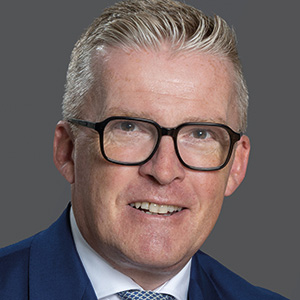
Dominic Griffiths, London managing partner
Mayer Brown
201 Bishopsgate
London EC2M 3AF
United Kingdom

T: +44 20 3130 3000
E: [email protected]

www.mayerbrown.com/en

Sponsored briefing: Key indemnification concerns in M&A transactions in Brazil

Machado Meyer’s Guilherme Bueno Malouf and Paulo Henrique Carvalho Pinto on the key points to consider when engaging with the Brazilian M&A market

Brazil has been in the spotlight for foreign investment for a while. Although the political scenario and global headwinds continue to affect our economy, Brazil has remained an attractive place to invest for a number of reasons, including its large internal market (size of its population), the need of enhancement of its infrastructure system and the scalability of its agricultural sector.

When investing into Brazil, foreign investors need to address the specificities of our legal framework. Key examples of challenges imposed on investors are as follows:

  1. The Brazilian tax system is very complex with different laws (including procedural laws) being imposed on taxpayers, a relatively unstable jurisprudence on tax disputes and a dispute among Brazilian states on tax holidays granted to taxpayers – thus it is not uncommon for Brazilian companies to be subject to continuous tax liabilities.
  2. Brazilian labour courts still apply interpretations of our labour laws that are protective to the employees, notwithstanding the fact that a recent labour reform was passed, which turned the labour relationships for dynamic and less subject to unfair litigation.
  3. Due to some particular features of Brazilian laws, it is not unusual to identify certain inconsistencies or restrictions relating to the registration of ownership/occupation of real properties, which may include (a) lack of certain licences; and (b) the existence of ‘permanent preservation areas’, ‘indigenous areas’ and/or ‘quilombola areas’, or (c) restrictions on acquisition of control of large rural areas, which in sum create excessive burdens on companies so they can develop their activities.
  4. Despite lack of express reference in applicable laws, environmental damage remediation in Brazil is not subject to statute of limitation, pursuant to scholars’ understandings and court decisions (including decisions rendered by the Supreme Court). Courts have also been consistent in considering environmental civil liability as propter rem which means that it is connected to the ownership or possession of a real estate, regardless of fault. In this sense, the owner and those who economically benefit from use of a land automatically assume liability for pre-existing environmental damages, even if the party did not actually cause them. On top of that, environmental laws set forth joint liability among polluting agents – a victim affected by an environmental damage shall not be required to sue all polluting agents in a single action (a certain company may be chosen out of all polluting agents).

The facts outlined above play an important role in M&A transactions in Brazil. Investors need to carefully evaluate tax and labour exposures (including materialised and non-materialised contingencies) of the relevant company, as well as the potential restrictions on the use of real property and related environmental risks.

Notwithstanding the fact that the due diligence is instrumental for the negotiation of the purchase agreement, mainly in so far as representations and warranties (R&Ws), indemnification and collateral provisions are concerned, it is worth pointing out that most of the M&A transactions in Brazil1 adopt the so-called ‘my watch-your watch’ clause, whereby sellers or issuers agree to indemnify the purchaser for losses deriving from acts, facts or omissions taking place at any time prior to the closing of the transaction, regardless of whether such events have a link to a breach of a specific R&W.

In light of the above, the question that rises is: if purchase agreements usually provide for a ‘catch all’ provision whereby purchasers have recourse against sellers and issuers for any pre-closing liability, why should purchasers need a robust set of R&Ws?

The answer is three-fold: (i) firstly, the R&Ws are informational, in the sense that they provide a relatively wide view on the company and its activities and serve as rule-book for purchasers post-closing; (ii) secondly, the R&W are also an important condition precedent to closing; ie, to the extent a R&W is not accurate at closing, a purchaser shall have the right to terminate the purchase agreement and (iii) thirdly and perhaps more importantly, not all R&Ws are covered or superseded by the ‘my watch-your watch’ clause, mainly those where a judgment is provided; eg, a R&W on the fact that the relevant company has sufficient insurance coverage in comparison with players in the same sector and of equal size, or a R&W that the company has all IP rights to develop its activities. Thus, if these R&Ws are incorrect and the company suffers a loss (spends money on buying new insurance or suffers monetary damage because of the lack of adequate coverage, for example), the purchaser will be entitled to claim indemnification based on the breach of the relevant R&W.

Also, one should also pay attention to these other very specific features of the indemnification package usually seen in Brazil:

  1. Time limitation: general statutes of limitation are three years, but certain matters have longer terms, such as taxes and labour (five or six years, depending on whether there is a discussion on the occurrence of tax fraud) and environmental (no limitation). Therefore, the negotiation of the time limitation for the indemnity will depend greatly on the findings of the due diligence, the sector in which the target company operates and the exposure that the target company bears across such various types of contingencies.
  2. Amount limitation: it is common practice for Brazilian purchase agreements to include amount limitations on the indemnification, including caps, de minimis, tipping basket and, in certain cases, a deductible. The negotiation of such limitations is also linked to the findings of the due diligence and the sector in which the target company operates.
  3. Indirect or consequential loss: Definition of loss tends to be one of the most relevant features when negotiating a purchase agreement governed by Brazilian law, as sellers want to exclude indemnification for indirect or consequential loss (eg, lost profits, loss of opportunities) to have a better estimate of the amount that they may have to disburse if the purchaser incurs any loss deriving from past liabilities. Although full indemnification for such losses is not standard, we have seen provisions whereby sellers agree that indirect or consequential losses are indemnifiable for specific events (eg, if the target company does not hold any specific licence to operate its business, for environmental and anti-corruption matters).

In light of the above, a thorough due diligence investigation is extremely relevant, so that purchasers have a full picture of materialised and contingent liabilities of the target company in order to properly negotiate an indemnification package from sellers.

Authors


Guilherme Bueno Malouf
Partner
E: [email protected]


Paulo Henrique Carvalho Pinto
Partner
E: [email protected]

  1. Mainly regarding private companies, as the pattern for listed companies is quite different, with purchasers relying on a representation and warranty on the public filings of the relevant company (under the assumption that the “market” prices the legal issues disclosed in such filings.

Return to the Deals Yearbook 2023 menu

Sponsored briefing: France: new regulations on shortages of health products and new challenges for the life sciences sector

LexCase

Diane Bandon-Tourret, partner and head of the life sciences practice at LexCase, and Tamara Milano, associate in the life sciences practice, consider new regulations in France aimed towards avoiding shortages of medical products

These last years, shortages became a major public health concern, highlighted by the Covid-19 crisis and the current shortages of major medicines. As a result, adoption of new regulations to prevent shortages have become a priority for many countries. In the EU, new regulations have strengthened shortages prevention, such as Regulation (EU) 2023/607 which extended the validity period of CE certificates issued under the previous regulation to avoid the unavailability of medical devices (MDs). In France, regulations on shortages recently evolved in the field of medicines, MDs and in vitro diagnostic devices (IVDs). Continue reading “Sponsored briefing: France: new regulations on shortages of health products and new challenges for the life sciences sector”

Sponsored briefing: Legal tech: Opportunities abound from AI 1.0

Kriti Sharma, head of product, LegalTech at Thomson Reuters explores how the legal sector must respond to the AI revolution

Kriti Sharma is an overachiever, having held senior tech and advisory roles at HSBC, Sage, the UN and Barclays, and been named among Forbes’ 30 under 30 list. She still heads up an NGO she founded called AI for Good. Now, she is also chief product officer, legal tech at Thomson Reuters. Continue reading “Sponsored briefing: Legal tech: Opportunities abound from AI 1.0”

Sponsored briefing: Q&A with Darren Kantor, director, global head of legal tech implementation and recruitment at Jameson Legal Tech

What have been the main trends in legal tech recruitment over the last year?

We have seen legal tech employers place greater emphasis on technical skills, such as coding, data analytics, and artificial intelligence. This reflects the need for legal tech professionals who can effectively develop, implement, and manage technology solutions.

What we are really proud of in the legal tech space is the growing recognition and importance of diversity and inclusion.

Many legal tech employers are implementing strategies to foster a more inclusive workplace.

Have you seen demand increase for legal tech professionals?

I think with the ongoing digital transformation in the legal industry, there has been a growing demand for legal tech professionals. This trend was really fuelled by the pandemic, where there had almost been a pause on new projects, and once we came out the other side, the market just exploded – so many tech companies creating innovative products and solutions, and law firms and corporate legal teams wanting to be at the forefront of this tech. However, with all this tech available, the one thing that is always imperative is that you must have the right people in place to implement and help with the adoption of technology in the legal sector. This market has been quick to realise that tech and the professionals running this tech come hand in hand, which is why there is such a demand for legal tech professionals right now.

What have been the biggest drivers of activity?

Some of the biggest drivers for recruiting legal technology professionals is a combination of technological innovation, changing client expectations, and the need for greater efficiency and cost-effectiveness in the legal industry.

How do you see the recruitment market evolving over the next few months to a year?

While there is still a continued demand for legal tech professionals, there is also an increased competition for talent. Therefore, we are going to see more employers looking at ways to make their organisations stand out, with benefits like employee perks, remote working, skill development, and career advancement being offered.

We are also going to see a lot more use of AI in our day-to-day tasks, from training, researching, knowledge and many more uses as the technology advances.

For more information, please contact:


Darren Kantor, director, head of legal tech implementation and recruitment

Jameson Legal Tech
24 Greville St
London EC1N 8SS

T: +44 (0)20 3950 0534
M: +44 (0)7961 153 478
E: [email protected]

www.jamesonlegal.com

Sponsored briefing: Q&A with Jon Bartman, head of Jameson Legal Tech

What have been the most important developments in the legal tech space over the last year?

Automation is everywhere and automation is the key word this year. This doesn’t just mean large language models, although they are important, but automation can come in many different guises. Let’s deal with the elephant in the room. GPT4 is most definitely a game changer, but the next 12 months will prove how much of a change it will bring. Finding solutions that work with the way that lawyers and the infrastructure work is crucial. Data integrity is also paramount, and of course understanding how data is stored and used is also going to play an important role. Continue reading “Sponsored briefing: Q&A with Jon Bartman, head of Jameson Legal Tech”

Sponsored briefing: Law firms see a hybrid future enabled by the cloud

New research has revealed that law firms are increasingly shifting to hybrid working and cloud technology is underpinning this move

This article will look at some of the key findings to emerge from a new benchmarking study, undertaken by Legal IT Insider in association with Philips, that interviewed a range of leading law firms on their hybrid working plans and cloud strategies. It will also outline how the Philips SpeechLive cloud-based dictation and transcription workflow solution can help to address specific issues associated with the hybrid work approach, not least the concerns associated with cyber security.

Moving to the cloud

Following on from the global pandemic we have seen the rapid growth of the hybrid work model where employees have the flexibility to work a portion of their week from home, with the remainder of the time spent in their office.

Law firms have certainly embraced this model, recognising its growing popularity and the expectation of staff to have greater flexibility in where they work. In fact, the study indicates that 88% of respondents now have some form of policy in place to support it, while only 2% are making it mandatory for their staff to be back in the office full-time.

The result is that law firms are increasingly looking for new opportunities to support lawyers more effectively, by enhancing collaboration, streamlining processes and allowing for device and location-independent mobile working. All of which are major strengths of cloud technologies.

It’s no surprise, therefore, that the study results show 68% of respondents confirming that more than half of their core systems are now cloud-based. In contrast only 9% are still using predominantly on-premises solutions.

Another significant finding is that 79% of the respondents already have a cloud-first strategy. This is an approach to cloud computing that involves the adoption of cloud technologies for all new applications, platforms and infrastructure. In effect it prioritises cloud computing services over more traditional on-premises IT systems.

The growing shift to the cloud is also emphasised in terms of the overall strategy adopted, with 12% of respondents reporting that they are already entirely cloud-based. What’s more, a further 23% plan to be entirely cloud-based within 18 months, while 19% intend to follow suit in three years.

And cloud-based solutions have played an important part in helping legal firms to support hybrid and remote workers more effectively. For example, one of the most significant changes that law firms have seen in adapting to hybrid working has been the increasing reliance on Microsoft 365, with 56% of respondents having recently moved to this software as a service (SaaS) product.

Another commonly reported change has been the surge in adoption of eSignature usage (cited by 72% of respondents). This use of IT to authenticate the signatory and certify the integrity of the document is mobile-friendly and secure, and thus ideally suited for a hybrid work environment where colleagues and business partners will often be working remotely.

SpeechLive and the cloud

Streamlining document production processes and enhancing collaboration are major challenges for all law firms. Philips SpeechLive is a cloud-based solution that is suitable for businesses of all sizes and is ideally placed to meet these challenges. It allows legal professionals to use its advanced speech recognition and workflow capabilities to create and route documents through the production processes. Document creation can be carried out:


  • in the office via a microphone and browser-based solution; or
  • on the go using a portable voice recorder, or a mobile app which supports both Android and iOS devices.

Front-end speech recognition can also be used to directly insert text into existing software applications, such as Microsoft Word, Outlook or CRM systems, along with case management systems.

SpeechLive’s AI-based engine offers up to 99% accuracy, while voice commands can be used to insert paragraphs, punctuation marks and special characters, all contributing to speedy and effective speech-to-text conversion.

Uptime reliability can be a concern with some cloud-based solutions due to issues such as power failures or network outages. With this in mind, Philips has partnered with Microsoft Azure as its hosting provider. Azure promises a 99.9% uptime guarantee, 24 hours a day, seven days a week and 365 days a year.

Security findings

Inevitably much of the information generated by legal firms will contain personal information that is sensitive in nature. Ensuring such information is safe from the prying eyes of online hackers is paramount. Security, therefore, is a crucial issue for both existing and potential users of cloud-based solutions.

In the past a range of concerns were often expressed by both law firms and their clients regarding the security of documents stored in the cloud, particularly public clouds.

However, results from the study demonstrate a growing confidence in the levels of security now provided by cloud service providers. It found that 73% of respondents believe none of their clients are unhappy or uncomfortable with their data being stored in the cloud, while a further 21% expressed only minor reservations.

Reinforcing the above point, 74% of respondents believe that cloud solutions are now more secure than their on-premises counterparts.

This appears to have resulted in a change of emphasis in terms of the security-related concerns expressed by the clients of law firms – they are less concerned about where the data is hosted, and more about how it is actually protected. One respondent commented ‘It is impossible for on-premises to be as secure as the cloud. Security technology requires a level of scale and investment that cannot be achieved on premises.’

SpeechLive and security

There is a growing confidence that cloud service providers can offer extremely high levels of security, not least because their businesses and reputations depend on it.

This is certainly the case with SpeechLive. For example, the use of multi-factor authentication (MFA) adds an extra level of security since it requires two or more distinct factors to validate a user’s identity, rather than relying on just a simple username and password combination.

In addition, encryption techniques are employed to create a layered defence that makes it more difficult for an unauthorised person to gain access to audio recordings and file attachments. All types of audio files are always created, sent and stored with industry standard AES 256-bit encryption.

Importantly, the Azure hosting service also adheres to international standards for security and compliance. For example, the service is ‘GDPR ready’, meaning it fully complies with the European Union (EU)’s General Data Protection Regulation which seeks to ensure that EU residents’ personal data is secure, accessible, used appropriately and documented with consent.

In addition, Azure is certified for the ISO/IEC 27000 family of information security standards, in particular the mainstay of the series (ISO 27001) which sets out the specifications for an information security management system.

Azure also continuously performs penetration testing and work on threat detection and prevention in areas such as unauthorised intrusion and denial of service.

Five key takeaways

  • The appetite among staff within the legal sector for flexible and hybrid working has grown significantly, with the majority now expecting this work model to be made available to them.
  • Hybrid working is here to stay and the requirement to support it has accelerated transformation initiatives.
  • Law firms are increasingly choosing a cloud-first strategy where cloud technologies are adopted for all new applications, platforms and infrastructure.
  • Cloud technologies provide new opportunities for supporting lawyers more effectively.
  • Speech-to-text, workflow and collaboration solutions have key roles to play in streamlining processes and enabling lawyers to achieve greater efficiencies.

Reference

Hybrid Working & Law Firms’ Long-Term Cloud Journey
Cloud Report 2023 by Belinda Hermans – Flipsnack

For more information, please contact:

Ryan Braddock, VP and sales director UK and Ireland

Speech Processing Solutions UK Ltd
7 The Courtyards
Wyncolls Road
Severalls Park
Colchester CO4 9PE

T: 07825 751859
E: [email protected]

www.speechlive.com

Sponsored briefing: Litigation analytics brings hard data to high-stakes decisions

Grant McCaig, head of litigation at Phoenix Group, the UK’s largest long-term savings and retirement business, discusses the value analytics brings to high-stakes litigation decisions

The past few years has seen pioneering litigation analytics company Solomonic utilise machine learning technology and human expertise to create powerful structured data from unstructured litigation documents and judgments. This has, for the first time in English High Court cases, brought data and insight to the decision-making process. Continue reading “Sponsored briefing: Litigation analytics brings hard data to high-stakes decisions”

Sponsored briefing: Putting AI in its place: the rise of the litigation workspace

With AI and ChatGPT on the rise, Stephen Dowling explores how, and why, these new tools are a necessity for the future of dispute resolution

Litigation is undergoing a quiet revolution. Underpinning these changes are powerful AI and ChatGPT tools, which are ultimately changing how we work, and impacting on outcomes. The days of manual processes are numbered. Digital tools are now commonplace in litigation. But the next phase of development will see a harnessing of these tools to bring efficiencies never thought possible – with implications for those who do not adapt. Continue reading “Sponsored briefing: Putting AI in its place: the rise of the litigation workspace”

Sponsored briefing: Doing business in Greece

Theodore Pistiolis, managing partner of Andersen Legal in Greece, examines the benefits of doing business in the Greek market

A sea of opportunities

During the last years and despite adversities, Greece became an investment destination for local and foreign capitals. The perception of Greece as an investment destination is strong, and the country built trust and optimism about its prospects. Greece’s economy recorded solid growth in the first half of 2022, but rising inflation took its toll on growth in the year’s second half. However, the RRF program (Recover and Resilience Facility loans) supported the economy. Government measures cushioned the impact of energy prices on businesses’ input costs and households’ real disposable incomes. Continue reading “Sponsored briefing: Doing business in Greece”

Sponsored briefing: Outlook for the Greek legal market

Dimitris Zepos, managing partner of Zepos & Yannopoulos, on what the future holds for the legal market in Greece

The Greek legal market has traditionally been highly fragmented and therefore shallow, with freelance lawyers and small family-owned offices making up the lion’s share of the market. To be fair, small-scale business models have not been a particularity of the Greek legal market, but rather a replicate of the average Greek entrepreneurial model. According to the Hellenic Federation of Enterprises, 96% of SMEs employ up to nine people and this includes companies without any employees or with just one.

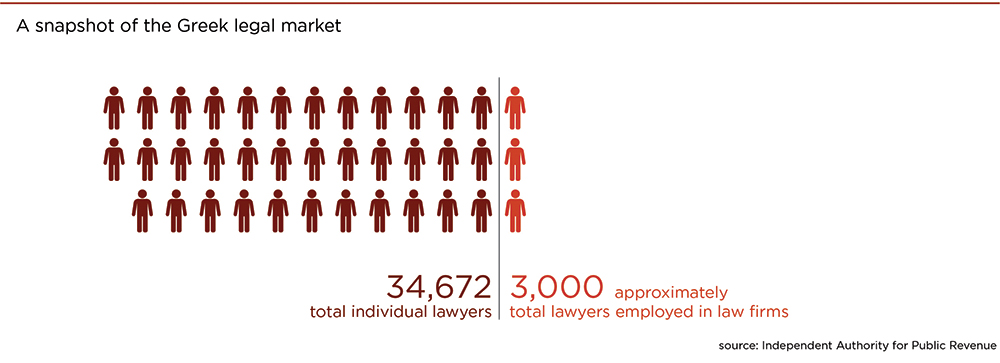
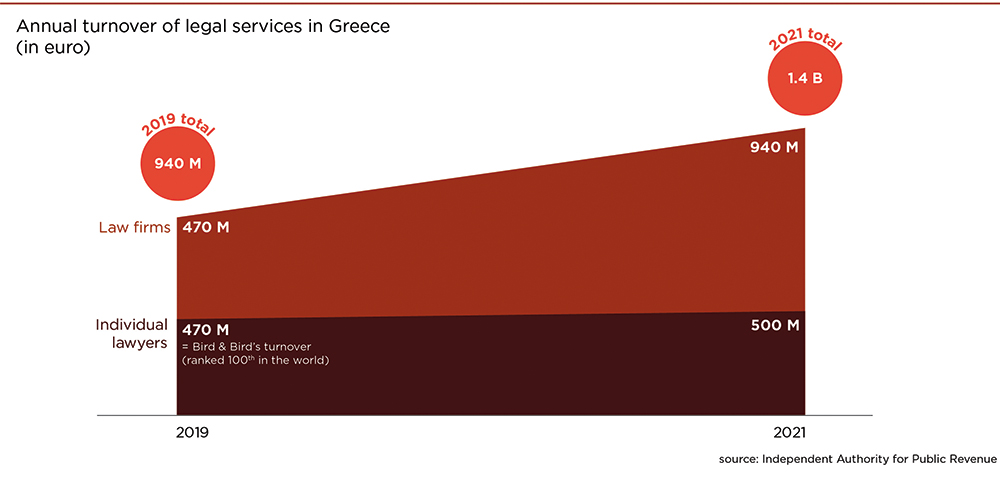
According to data published by the Greek Authority of Public Revenue, the number of individual lawyers has remained steady since 2019, amounting to approximately 35,000 (34,672 for 2021). According to the same data, the total turnover of legal services in Greece amounted to €940M in 2019, out of which, approximately €470M was generated by individual lawyers. This means that 35,000 individual lawyers generated approximately 50% of the sector’s total turnover in 2019. To put things in perspective this amount is equivalent to the annual turnover of one single international law firm, Bird & Bird, which in 2019 was ranked 100th in the world, based on turnover.

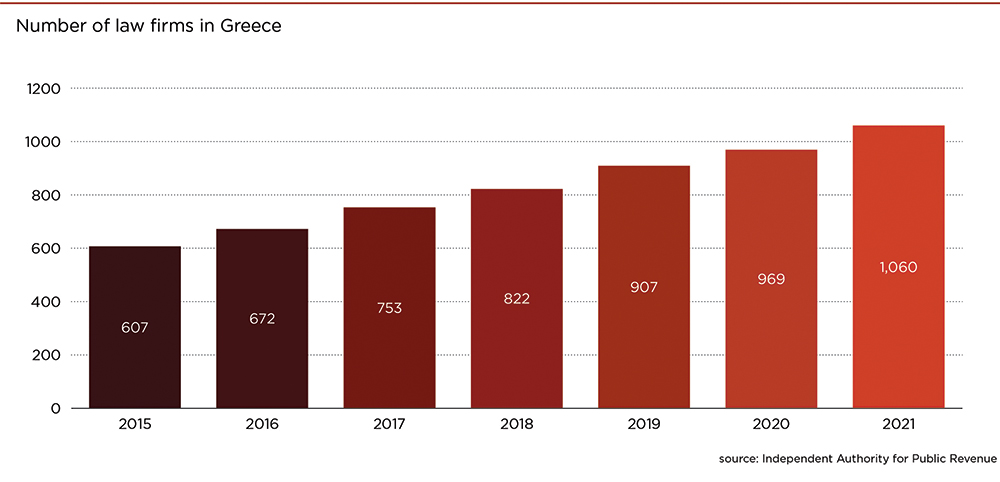
The figures in question have started shifting, indicating that the legal market is moving slowly, yet steadily, towards a more mature way of doing business. In 2021, the number of law firms increased to 1,060, compared to 907, back in 2019. The total turnover of legal services reached €1.4bn, growing by 60% compared to 2019. Out of that figure, approximately €940m of turnover has been generated by law firms, whereas the performance of individual lawyers has remained in the range of €500m. In other words, growth in the sector has been fuelled by the increasing number of law firms and their growth.

Fragmentation of the legal market is also evident when one looks at figures concerning headcount. The ten-largest law firms in Greece, based on headcount, employ approximately 600 lawyers in total, out of the approximately 38,000 active lawyers in the country.

At Zepos & Yannopoulos we have always believed that strength derives from teaming up. With a total team of 118 lawyers, 14 economists and 82 other professionals, we are proud to be within the top 3% of employers in Greece. Consolidating practices and people allows us to adapt to the pace of a constantly changing world, to foster legal talent and encourage innovative thinking, all to the benefit of our clients, our people and the community as a whole.

The legal profession in itself is changing. Firms are called upon to cater to a wide and complex range of comprehensive needs. The question is no longer whether the Greek legal market should change to adjust to this new era, but instead how fast it can do so.

For more information, please contact:

Dimitris Zepos,
Managing partner

Zepos & Yannopoulos
280 Kifissias Ave. 152 32 Halandri Athens, Greece

T: (+30) 210 69 67 000

E: [email protected]

www.zeya.com

Sponsored briefing: Greece: M&A outlook and FDI attractiveness from a legal and regulatory point of view

Early 2023 held a sweet spot for cross-border M&A activity in Greece, unmuting all those opportunities that had joined a waitlist during the Covid-19 pandemic and have been looking for the right time to be deployed and lead into new business models and scaling deal-making strategies.

In fact, the current market status suggests that deal-makers rebound with a strong intention to radically shift the transactional landscape by throwing into the mix highly sophisticated implementation plans and solid completion strategies, opening up to new industry sectors and playing up to transformational deals that will most definitely impact their core operations and medium-term strategic goals. Continue reading “Sponsored briefing: Greece: M&A outlook and FDI attractiveness from a legal and regulatory point of view”

Sponsored briefing: Legal trends in Greece

After overcoming a decade-long financial recession, Greece is currently going through a period of political stability and economic growth. During this period, the Greek government has taken a proactive role in charting a determined course for Greece that is friendly to investment, promotes growth and welcomes new business, primarily by enacting legislation that provides considerable incentives to investors.

In particular, during the year 2021, the Greek economy manifested a GDP growth of 8.3% and welcomed an increase of 90.2% in Foreign Direct Investment (FDI), in accordance with the data provided by the Hellenic Statistical Authority and Bank of Greece respectively. Continue reading “Sponsored briefing: Legal trends in Greece”

Sponsored briefing: Green bonds: the future of equity financing?

1. A BURGEONING INDUSTRY
Green bond issuance is expected to balloon over the next few years. On a global scale, predictions for 2023 alone estimate up to $600bn will be raised from green bonds, with Europe playing a leading role in this. The European Commission will fund up to €250bn over the next few years by issuing NextGenerationEU green bonds, making the EC the largest green bonds issuer in the world. Greece is expected to raise substantial amounts through green bonds in order to reduce greenhouse gas emissions by 55% by 2030 and achieve net-zero by 2050. Continue reading “Sponsored briefing: Green bonds: the future of equity financing?”